
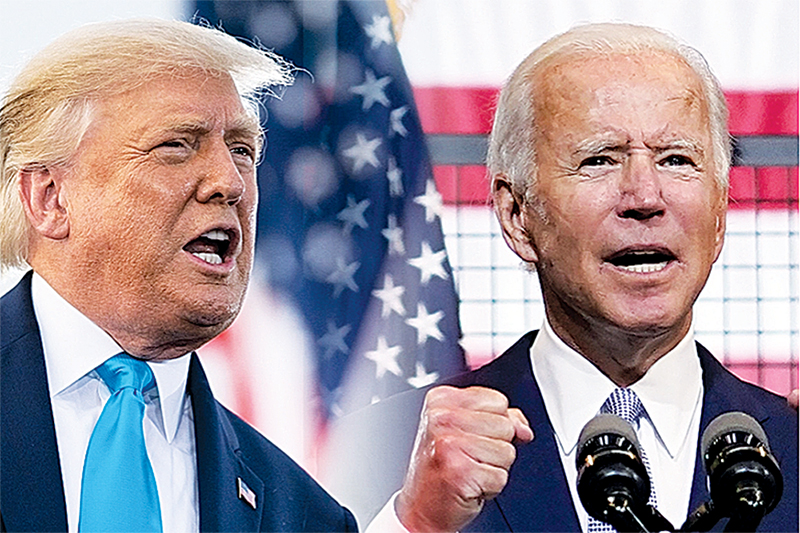
The presidential election is foremost on the minds of America with Election Day looming Tuesday, and the unprecedented political climate has spurred record numbers of voters to take to the polls early and through mail-in methods.
There is a lot of misinformation going around about what can happen in various scenarios after Tuesday night, and while Americans are used to staying up late and finding out who their next president is, that may not happen as easily this year.
The Northeast Georgian consulted two professors of political science to try and get to some insight about where we are headed with our executive succession.
There has been a lot of talk about one candidate or the other not “accepting” the results of the election. If the election is challenged in the courts and for some reason drags on for a couple of months, what happens on Jan. 20?
Dr. Carl Cavalli, University of North Georgia: It is not up to any candidate to accept the results or not (beyond requesting a recount or re-canvas in individual states if the rules allow). They may file legal challenges, along with just about any other voter. It is those legal challenges that are likely to keep the result in doubt for any length of time. Theoretically, if there is no president selected by Jan. 20, the new VP takes over. If there is no VP, then the House Speaker, until the presidency is resolved.
However, the more important deadline is early December, when the Electoral College casts its vote. With luck, legal disputes will be settled by then, but if not, states may step in.
There is no constitutional right for the public to vote for president. Constitutionally, presidents are chosen by state electors – who are selected by state legislatures. It is the state legislatures that have the final say over whose electors are chosen. All states have agreed to base their selection on popular voting, but it is not clear that states must abide by that result.
And of course, lingering legal disputes couldbump up against the selection deadline for electors.
Some states may step in and say there’s no time left – we’re going to end this by picking the electors ourselves. No state legislature has ever done that (though the Florida legislature threatened to do that in 2000). One important note: this year, the state legislatures of virtually every battleground state are Republican majorities. Consider also though, that any state legislature that tries to circumvent the popular vote may have a political price to pay via the voters in the next election. They will have to factor that into their consideration of how to act.
Dr. Tony Frye, Piedmont College: The last time there was a contested election, in 2000, the U.S. Supreme Court resolved this depute in the Bush v. Gore decision on Dec. 12, three days before the Electoral College votes were counted that year. It would hopefully not go beyond that date. If it does, we will have a Constitutional crisis.
Some of those scenarios could hypothetically include vote fraud claims (for mail-in ballots) in post-election ballot counts. Another case, the 2000 Presidential elections, the state legislature in question for that election – before the Bush v. Gore decision – convened a special session to certify its results and winner (had the Supreme Court not resolved the case before the Electoral College vote). Again, I would presume, but one never knows for sure, that there would be a court intervention to make a definitive decision on such a matter. The Supreme Court has already heard multiple appeals against the mail-in ballot law in Pennsylvania (including one on Oct. 28). All of this depends on if the election is close enough for it to matter.
It also has been said that Joe Biden will “shut the country down” if he is elected. What realistically is the executive branch’s power to do something like that if that were the desire of the new president?
Cavalli: The president’s national emergency powers can be vast, and they are mostly untested. But “shut the country down” is a vague, ill-defined term. We’ve heard a bit about the Defense Production Act in recent months. It allows the president to take control of business and shift whatever production capabilities they might have toward addressing a national emergency. Recall the suggestions early in the pandemic that Trump exercise this to get auto manufacturers to shift to producing ventilators. Most of the power to control public behavior belongs to states (think speed limits, zoning regulations, and public heath regulations) under “police” power.
While states have that power, the federal government has tremendous leverage in terms of funding. Most states currently receive significant amounts of federal funding for all sorts of things. The federal government has revenue-raising advantages over the states (if state taxes are high, you might move to another state, but if federal taxes are high, you are less likely to leave the country), so they can affect state behavior by threatening to withhold federal funding for all sorts of things (This is how the national 55 mph speed limit was enforced for many years. It’s also how states were coerced into raising their drinking ages to 21). So the bottom line answer is mixed. The president does have some power, but presidents have much more significant coercive power where money is concerned.
Frye: The President has accumulated a lot of power since the early 20th century. In particular, the National Emergencies Act, along with numerous executive orders issued by presidents past (and are still in effect), can give a President the potential power to try to take more vigorous federal action. There is some Congressional oversight stipulated in the National Emergencies Act, but for the most part the President is empowered to make those decisions as a unitary executive.
However, it should be noted, if there was an attempted national shutdown (depending on what that meant), it would probably be legally challenged, particularly by state governments who would object to the conditions of such a “shutdown.”
And like with a contested election, this would likely go to the U.S. Supreme Court to resolve or set the parameters on presidential powers in times of a national emergency. In most cases, historically, the U.S. Supreme Court will side with the President, but that is not always the case. In addition, just as states that were opposed to some of President Trump’s policies, especially on immigration, enacted ordinances and laws to countermand and protest the federal government’s actions, I would presume the same might happen in some states on the other end of the spectrum with a Biden Administration, objecting to governmental restrictions through the federal government (assuming that this is what a shutdown situation would look like after the election). In this case, the details of the shutdown would guide the response to it.
President Trump implied that the stimulus package will be more likely to go through if he is re-elected, rather than if he is a “lame duck” president for the next two months? Is that a political tactic ever seen before in our presidential elections?
Cavalli: All candidates say they would be able to achieve things the other candidate can’t. If anything, lame duck status may free up both the president and members of Congress to tackle things they might have resisted otherwise.
Frye: President Trump may be right in his thinking, but in fairness the parties are so polarized at this point I am not certain that a re-elected Trump (assuming he is still working with a Democratic-controlled House) would be able to negotiate more easily with Congress. Also, the Republican-controlled Senate seems not to be very cooperative, seeing any compromise with the House as potentially harmful, so the President would need to be able to navigate his own party’s reticence on a relief bill. We shall see.