

Lane Gresham
Clarkesville has a storied history of hospitality.
From its earliest days as an established village, demand existed for lodging.
At one time, large hotels dotted the square with smaller establishments and private homes filling up with guests eager to visit the wondrous sites of remote Northeast Georgia.
All sorts of individuals came to town – people involved with court cases or other business in the county seat, tourists and those simply in town for a singular purpose.
One guest traveled to Clarkesville in June 1883 on a particular assignment for The Atlanta Consitution.
His task: find and report on the miraculous cure of Ellington Cody [E.C.] Hawes, who suffered most of his life with a scourge of the day – scrofula. The affliction is a tuberculosis infection of the lymph nodes in the neck, which causes external lesions.
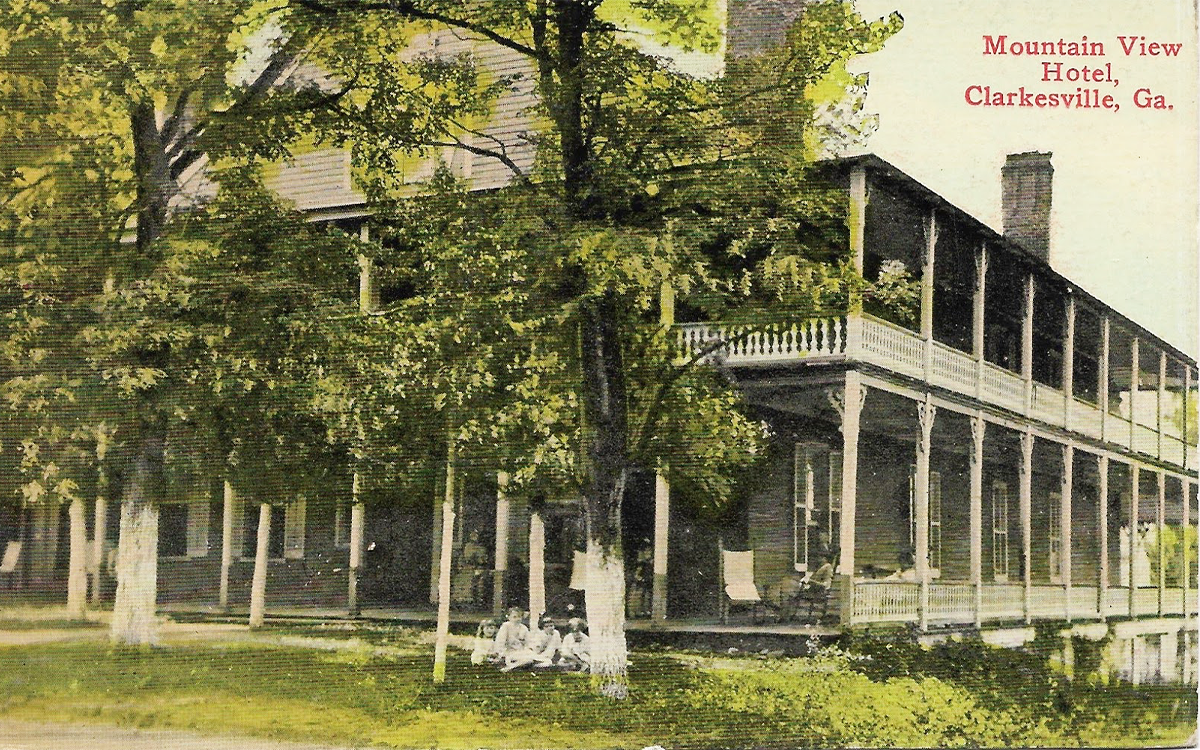
The reporter was directed to one of the hotels on the downtown square; perhaps it was the Mountain View, which occupied lots 3 and 4 on the western side of the town square or the Spencer Hotel on the opposite side.
Picture, if you will, the reporter walks into the dining room seeking someone with some sign of this disorder.
“I looked around the table at the 10 or 12 gentlemen were sitting, searching for the afflicted man that I come to see,” he stated in his report. “I picked out two different people at the table who showed signs of scrofula and a severe wrestle with S.S.S. [Swift’s Southern Specific tonic], but I could not determine which of the two was destined to be bored by a newspaper interviewer.”
It wasn’t until after supper that the reporter was introduced to Hawes, whose countenance bore no sign of the disease in question.
Hawes [1858-1889] is described as reluctant to provide testimony for the patent medicine S.S.S. because of his background as a physician’s son.
“In January of this year, I commenced to using S.S.S. This medicine had been recommended to me before … I was raised up with a prejudice against patent medicines, but finding out later that a great many of our best physicians were recommending S.S.S. and giving it to their patients, I overcame my prejudice and determined to give it a fair trial.”
After three weeks, he said the sores started healing, and his hair grew again. He also gained weight, and his nervous system was greatly improved.
“Since then, I have continued to improve rapidly in every respect,” he added.
Hawes, a prominent local citizen, married to Florence Byrd, served as principal of a local school. His word must have been valuable to the company that developed and marketed the tonic.
One can find versions of this reporting in vintage newspapers across the region, and one can surmise that perhaps Hawes’ story and other testimonies were made possible by an expansive advertising budget provided by the company providing the cure. Online searches reveal several examples of vintage advertising brochures for the company.
S.S.S. was established in 1826 with a healing “tonic for the blood” formula bequeathed in 1821 from the Creek nation to Capt. Irwin Dennard of Perry, Georgia, for saving the life of one of the Creek chiefs.
Dennard sold the formula to Col. Charles T. Swift, another resident of Perry. Swift partnered with Col. H.J. Lamar of Macon to bottle the tonic. In 1873, the partners moved the company to Atlanta, where it remains in business today, with its website claiming it as “one of America’s oldest pharmaceutical companies.”
The original recipe of native roots and herbs shared by the Creeks was later fortified with iron and vitamins to enrich the blood. The products were sold throughout the U.S. and abroad, claiming to cure various ailments, such as dyspepsia, cancer and syphilis. Its website still offers a version of the tonic, described today as “a therapeutic dosage of iron.”
Another interesting connection is that Swift’s daughter and heir, Maibelle Swift Dickey was the mother of novelist and poet the late James Dickey, famed author of Deliverance. The movie version of Deliverance premiered 50 years ago on July 30.
As for Hawes, he rests with the Byrd and Addison families at the Old Clarkesville Cemetery.
E. Lane Gresham is a writer, photographer and community lover. She serves as the chair of the Historic Clarkesville Cemetery Preservation, Inc. Board of Directors and as the Director of Communications and Media at Tallulah Falls School. She can be reached at elanegresham@gmail.com.